|
If you are planting bare root trees this January, you may need to provide tree supports for the first year or two. There are two reasons for staking trees: structural support and protection from human activities. An errant weed whacker can girdle a young tree and kill it before it has a chance to get started, and that bad driver can destroy your investment before it takes root. Tree supports should be installed when the tree is planted to avoid disturbing or damaging tender root systems. Tree supports should be placed one foot from the tree, with no branches touching. Structural support, or anchor staking, prevents the root ball from moving while the new roots are established. Tie your your tree to 2-4 posts with straps. Do not use rope, wire, or hose segments, as these put too much pressure on a narrow area, risking bark damage. Straps spread the pressure out over a wider area, keeping the bark healthy and intact. Since your tree will be growing, be sure to keep the strap around the trunk loose.
There is a correct height for tree support ties. Too low and no support is given. Too high and the tree won’t learn how to stabilize itself. To determine the correct height, grasp the trunk of your floppy new tree and gently try to bend it over with the other hand. As you move your hand up the trunk, you will reach a point where the flop ends and the tree bounces back to an upright position. This is the magic spot. Your stakes should only be a few inches taller than this height to avoid damaging new branches as they come in.
We've all seen some crazy things embedded in trees. But those trees are worse off for the invasion. Strong winds ripped a heavily laden branch from one of my orange trees in January 2016. While the damage was unfortunate (and preventable), the heady aroma was purely delicious! 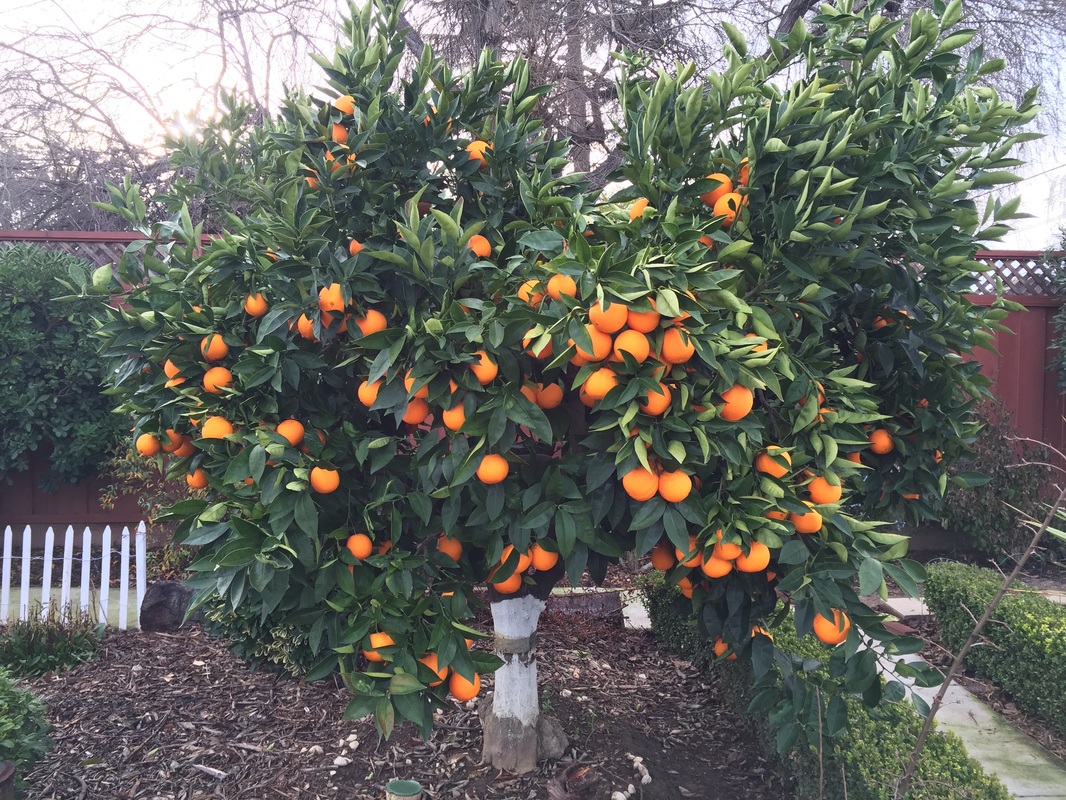 Heavily laden (and poorly pruned) Navel orange tree After pruning the damaged limb to help it heal faster, I plucked the fruit and gave it a good wash before bringing it in, hoping it was ripe enough. By the way, citrus trees have wicked thorns! Be sure to use caution when working in or around them. Citrus origins There’s no mistaking the heavy, oily skin of citrus. This skin provides moisture holding protection from its subtropical origins. Hailing from Southeast Asia and Australian, modern citrus fruits evolved from small berries found on pummelo, citron and mandarin orange trees. Crossing these three ancestors in different ways has led to the creation of oranges, lemons, limes, grapefruit, tangelos, kumquats and dozens of other variations. How to grow citrus Citrus trees and shrubs grow easily in warmer regions. They can be put in the ground or grown in containers. They prefer well drained soil and as much sun as you can provide. Since the fruit is very heavy, it is a good idea to protect them from heavy winds. Citrus trees can produce for 50-100 years, so use care when selecting a site. Be sure to feed and water your citrus regularly for maximum production. One-year old trees should be given 1/10 of a pound of nitrogen each year, while mature trees will need approximately 1-1/2 pounds. These amounts should be divided into three separate feedings in April, June, and August. If your trees are stressed by drought, you may want to spread those feedings out, using lighter amounts during the growing season, February through May. Blood meal is an excellent source of nitrogen, without all the fillers. Watering citrus Dumping too much water on your orange tree can leading to splitting. Split citrus are usually not ripe enough to eat but they provide the perfect breeding ground for bacteria, fungi, and other pests. Like mummies, they should be discarded as soon as they are seen.  Citrus fruit split Harvesting citrus
Knowing when to harvest your citrus can be tricky. Lemons and limes have distinct colors when they ripen, but Valencia oranges may still have a greenish tint to the skin when they are ripe. The only reliable way to tell if your fruit is ripe is to taste it. Unlike climacteric fruits, citrus does not continue ripening once they are removed from the tree. The best place to store your citrus is on the tree. If you do pick more fruit than you can use (or a branch breaks, dumping two dozen oranges in your basket), you can store them for 4-6 weeks in the refrigerator. You can also treat yourself with some fresh squeezed orange juice or a lemon drop! Personally, I grated the zest from two oranges over some sliced beef, juiced four oranges, and stirred in some corn starch, soy sauce, ginger and a pinch of Ghost Pepper for a delicious Spicy Orange Beef Stir-fry. Citrus pests Once established, citrus trees are pretty rugged. Here are some common citrus pests:
Citrus production Citrus trees are heavy producers. A mature tree can produce up to 300 oranges a year. Do the math and that comes out to over 130 pounds of oranges! If you find yourself swimming in citrus, here are some fun uses for lemons: • Remove fish smell from hands • Neutralize alkalinity from masonry work or Burning Man gear • Combine with salt to clean copper • Apply to stains on fabric and leave in the sun • Grind up peels in the garbage disposal for a fresh scent • Rub lemon on mold and it disappears! • Make your own invisible ink! Do you have any good ideas for using citrus? |
Welcome!You can grow a surprising amount of food in your own yard. Ask me how using the contact form on the Home page. If you enjoy what you are reading and learning, I hope you will buy and share my gardening books and leave positive reviews.
Thank you!  Index
All
Archives
October 2026
|


 RSS Feed
